When a unique opportunity presents itself, why not take it? Inspired by discussions with the team from the Spadone Project, we contacted the depositary of Markušovce Chateau in the Spiš region (Eastern Slovakia). According to previous findings published more than a decade ago on the TŠC website, the depositary holds a historical feder. After explaining our goals, the curator of the depositary allowed us to inspect the item, and so we embarked on a little quest.
To our pleasure, Mr. Ráčay showed us not only the feder, but also a beautiful Renaissance longsword, an apparently used Ottoman(?) saber, and a late Renaissance rapier. A disclaimer: there should be a big “probably” attached to every item, because their provenance still raises many questions, even after our inspection. In this article, we will describe our findings regarding the two main items from the collection: the Spiš Federschwert and the Spiš Longsword and we’ll briefly go through the two others.

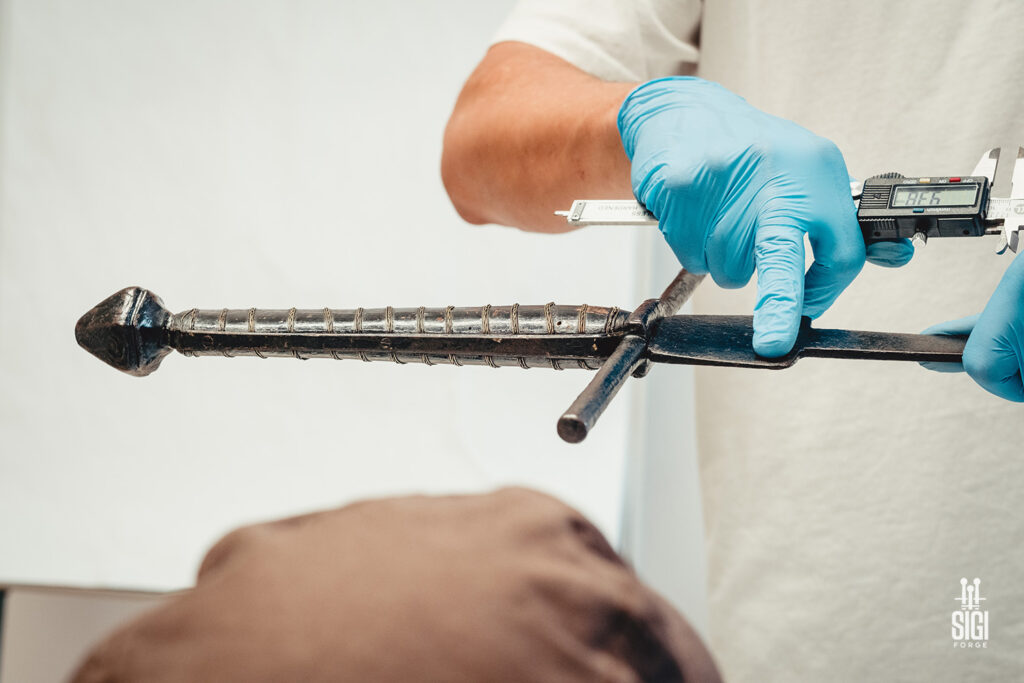
Jakub and Ondrej in the process of measuring the Spiš swords
The Markušovce Chateau Collection
In general, a large number of weapons displayed in Slovak museums were made in either the 19th or 20th century. The best historical pieces are often hidden away in private collections or museum depositaries, unavailable to the public. The Markušovce Chateau houses a depositary containing the complete inventory of the so-called Csáky Collection. The Csákys were an influential noble family residing in the wealthy Spiš region. They once owned the majestic Spiš Castle, located not far from their residence in Hodkovce.
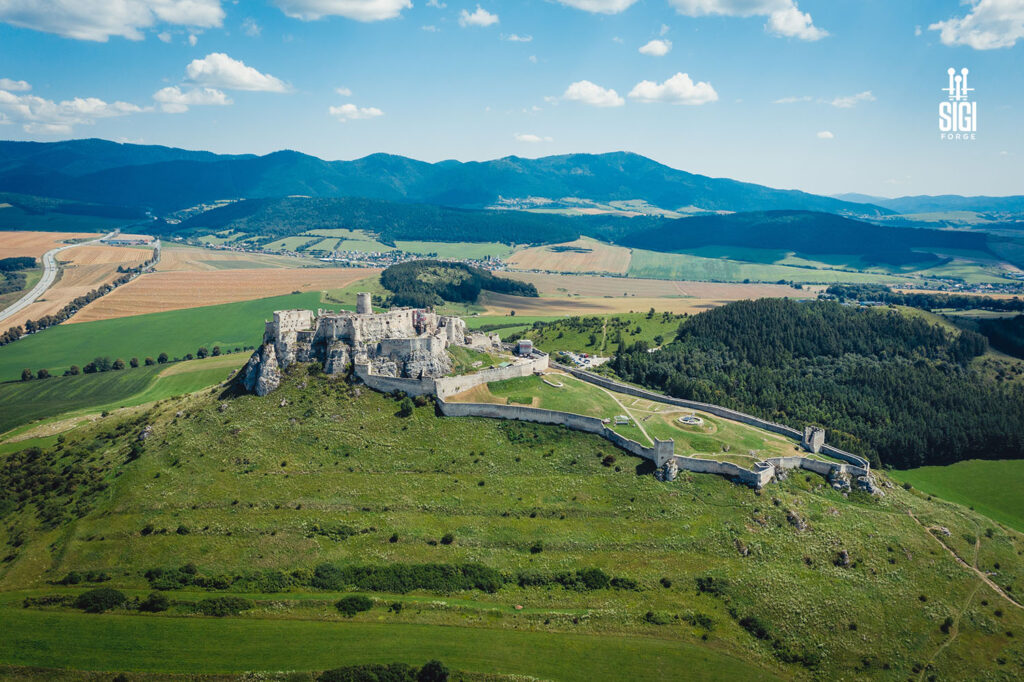
Spišský hrad / Spiš Castle, photo by Martin Fabian (2020)
When Spiš Castle was abandoned following the tragic fire that sealed its fate after a series of uprisings by the lower nobility, the Csáky family moved the remaining inventory, including the weapons, in 1780. Unfortunately, we do not know whether the swords we examined were part of that inventory.
In 1959, the complete inventory of the Csáky Chateau in Hodkovce was donated to the Markušovce Museum, where the majority of the militaria can still be found today. It is perhaps thanks to the unusual shape and appearance of the federschwert that almost nobody paid much attention to it, and it remained largely unnoticed by the wider public. The feder resurfaced in year 2010, when TŠC published the find on their website.

Early 20th-century photograph from the Csáky Collection provided by Mr. Ráčay. Notice the feder in the lower-right corner, along with the rapier hidden behind the vases.
Besides the federschwert, there are three other notable pieces in the collection:
- A Renaissance complex-hilt longsword (Spiš Longsword)
- A late Renaissance rapier
- A saber, perhaps of Ottoman origin
The remainder of the militaria consists of standard military sabers and rifles.
Thanks to the generosity of Mr. Ráčay, the curator of the collection, we were able to examine all four of the aforementioned pieces.
The Spiš Federschwert
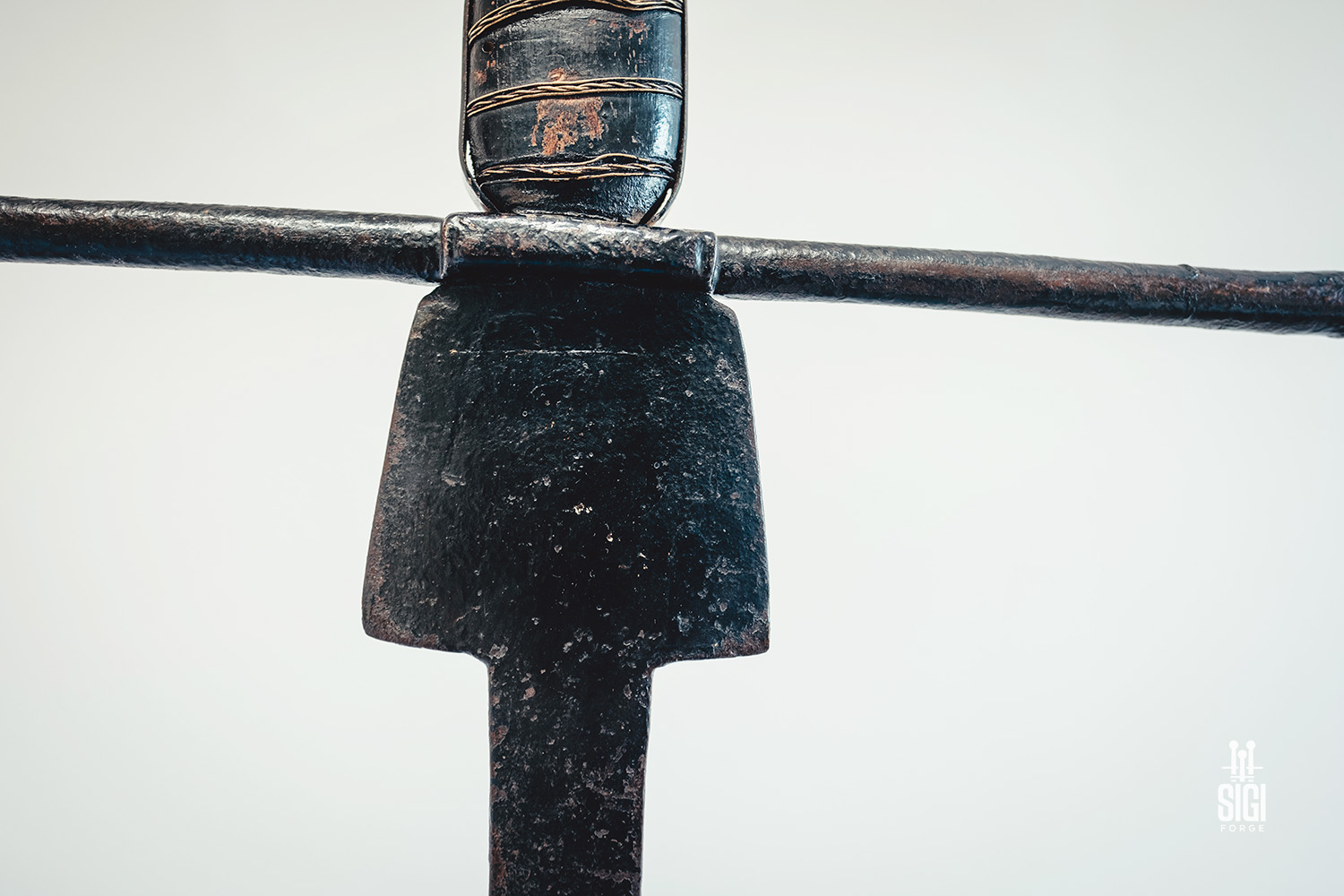
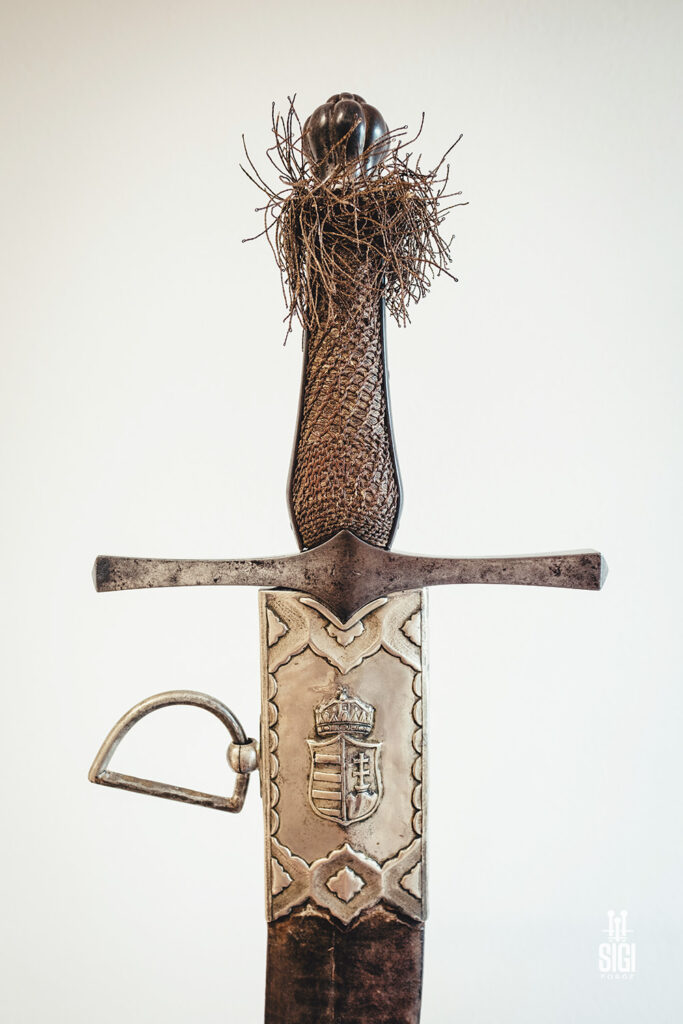
The black federschwert of Spiš is certainly a unique piece among surviving federschwerts. At first glance, the sword appears more modern than historical—the highly unusual pommel and grip construction are certainly not original. Even if we closed our eyes, the screws on the sides of the grip could hardly be mistaken for anything other than a modern addition. Just a note: when we say “modern,” we mean 19th- or 20th-century modern.
Apart from some light corrosion, the feder is more or less completely black. We assume this was a deliberate design choice, as the sword appears to be covered with a mixture of wax and soot, which was one of the traditional methods of blackening steel (we use a similar method on our buckler bosses). Prolonged handling of the sword left yellowish marks on our gloves, which further supported this assumption. If given the opportunity, we would gladly remove this coating from the blade and reveal its original steel appearance. 🙂
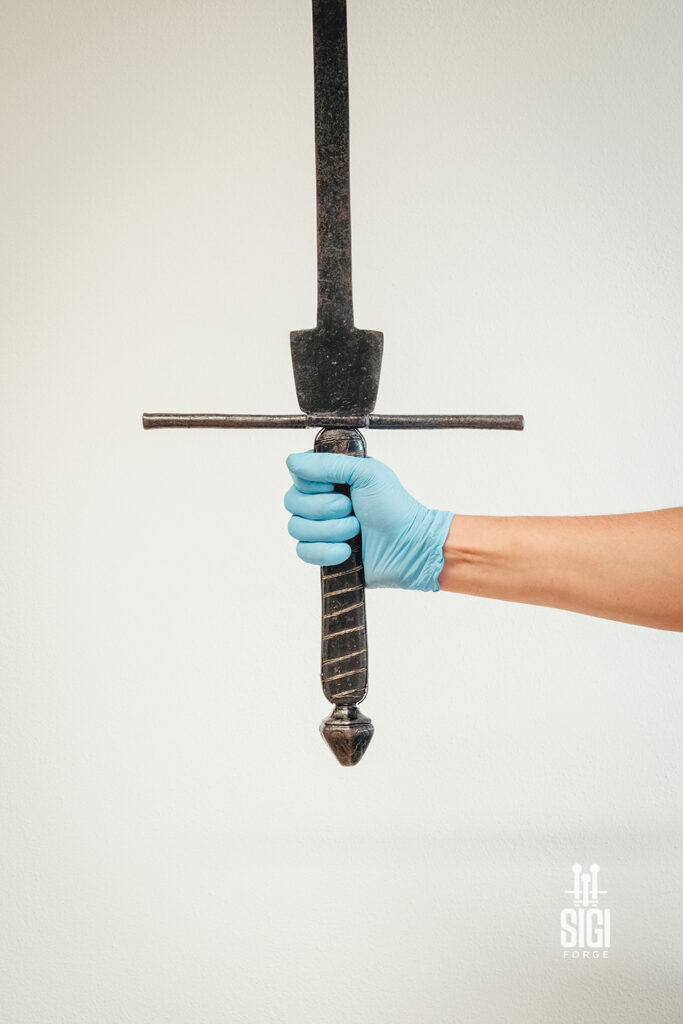
Thanks to Mr. Ráčay remembering a saber elsewhere in the collection, we immediately noticed the similarity between its hilt construction and that of the feder. The grips are nearly identical, held together by iron plates screwed into a wooden core. It therefore seems very likely that the same person either created—or, more likely, refurbished—both swords at some point in their history.
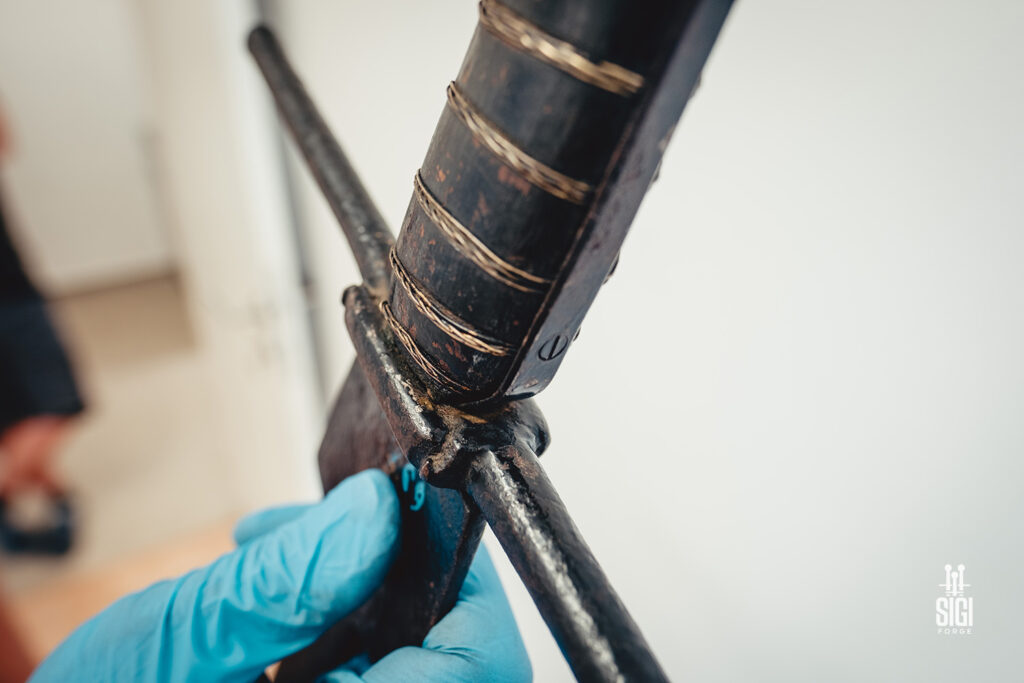
Notice the screws on the side of the handle. Same design appears on the examined Ottoman saber
This would also suggest that the feder is threaded rather than peened. We could not confirm this, as the peen was not visible and the sword was covered in wax or some other coating. If the sword could be disassembled, an inspection of the tang would significantly improve our understanding of its provenance. We suggested this possibility to Mr. Ráčay and hope that the museum may allow such an examination to take place in the future.
However, the most interesting part of the feder was undoubtedly the blade. Its shape and distal taper are remarkably similar to those of other surviving feders. A substantial mass in the first half of the blade is followed by a thin schwech (or debole), closely matching examples known from historical collections.
The blade becomes almost sharp toward the tip, which is not unusual. Researchers and HEMA scholars have suggested that this may have been an intentional design feature, making it easier to inflict bleeding wounds for a specific tournament purpose.
The sword felt rather stiff. We estimate its flex at approximately 13–15 kg according to both major measuring methods. Out of respect for the historical piece, we did not push it very far, but swinging the blade flatwise revealed a noticeable wobble around the midpoint, corresponding to the blade’s taper.
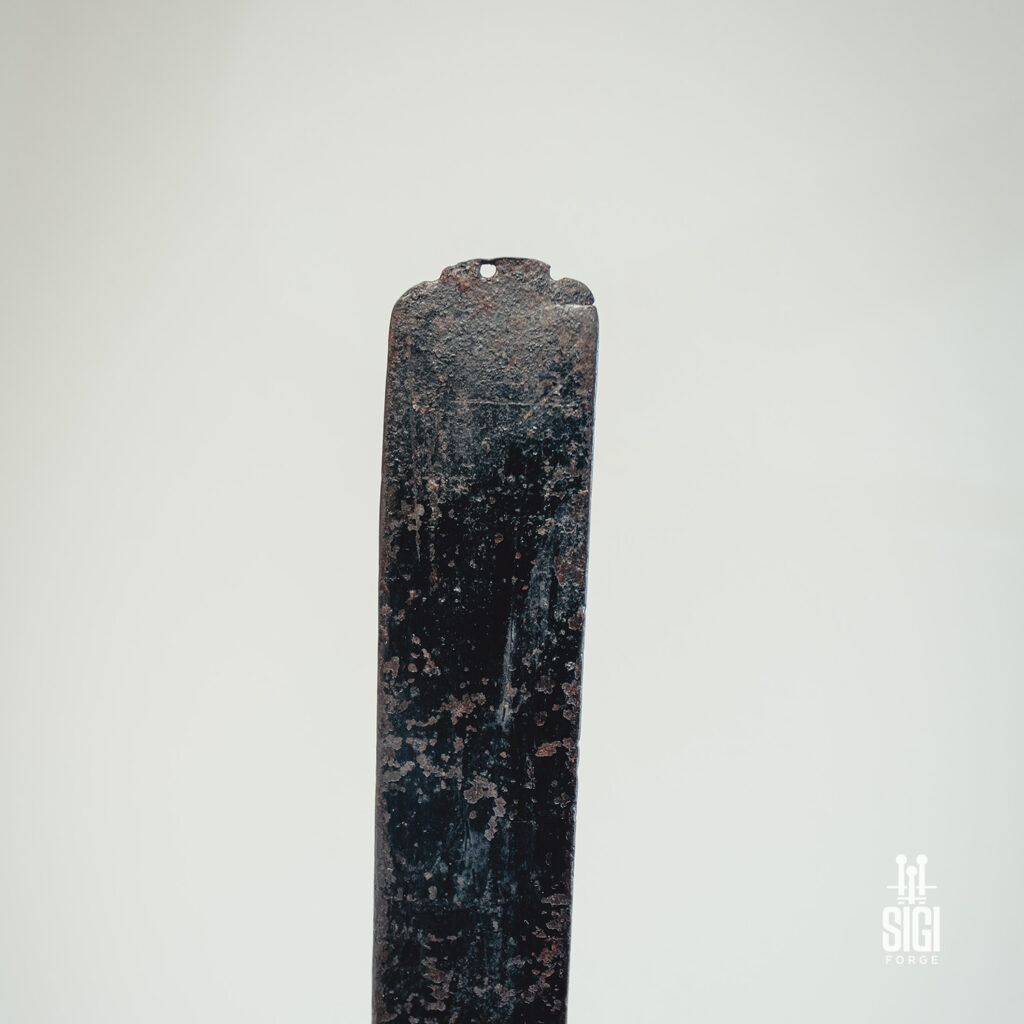
The tip of the sword sparked even more curiosity. It features three small holes positioned very close to the edge. Two have been partially damaged by corrosion, while one remains fully intact.
The unusual placement of these holes may theoretically have served one of two purposes:
- Attaching a cloth, sack, or some other unknown accessory for additional safety. This is plausible, but difficult to assess, as the proximity of the holes to the edge would create a structural weakness that could potentially tear under forceful impact.
- Serving as a mounting point for display. The sword could have been hung on a wall without visible nails, or perhaps suspended from the ceiling using a cord. This is admittedly a wild guess, but considering how close the holes are to the edge, it seems somewhat more likely than the previous explanation.
Within the limits of what we considered appropriate for a historical object, the sword handled reasonably well. We tried swinging it both slowly and quickly. The grip, however, is terrible. It appears to have been made by someone working more from imagination than from practical fencing experience.
The sword is heavy and noticeably forward-weighted, but this is not unusual among surviving historical examples. All things considered, it did not feel much worse than some genuinely old and rather clunky replicas. Nevertheless, the average modern HEMA practitioner would probably consider it cumbersome and poorly suited to the intricacies of today’s HEMA zeitgeist.
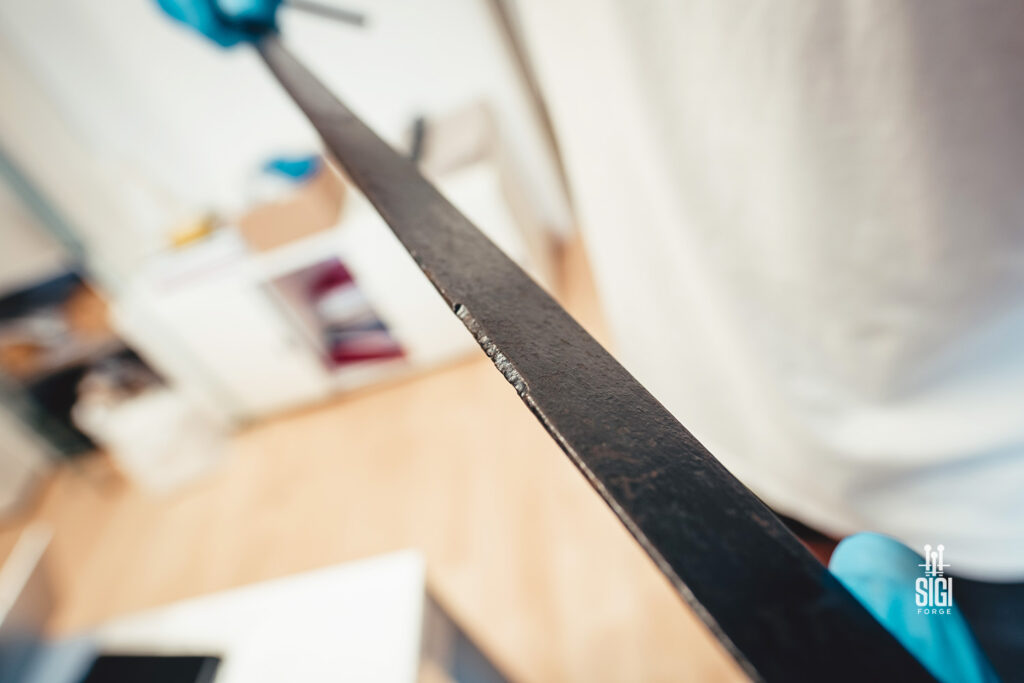
Detail of the blade. There were but a few knicks though a large portion near the tip was missing. If the feder was actively used, the burrs must have been filed away
If we were able to inspect the tang, we would likely learn much more about the sword’s origins. Based on what we were able to observe, we believe the blade itself may well be historical. Yet even if the entire sword ultimately proved to be a historicist piece or a 19th-century forgery, it would lose none of its interest to us.
There are simply too many unanswered questions. Most notably: why would a noble family in Spiš own such a specific type of sword? Could it have been connected to some early form of HEMA revival? If it was acquired as a souvenir, where did it come from, and why was it purchased? The object remains fascinating regardless of its ultimate dating.
Below you can find the main measurements we recorded from the sword:
Spiš Feder (16th-early 20th century)
Weight: 1875 g
Total length: 1262 mm
Blade length: 970 mm
Hilt length: 292 mm
Crossguard width: 314 mm
Schilt width: 78 mm
Schilt height: 75 mm
Thickness at the crossguard: 8.8 mm
Thickness at the middle: 3.5 mm
Thickness at the tip: 1.5 mm
Pommel height: 54 mm
Pommel width: 43.5 mm
POB: 95 mm
Pivot 1 (crossguard hold): 600 mm
Pivot 2 (pommel hold): 270 mm
COP: 640 mm
The Spiš Longsword
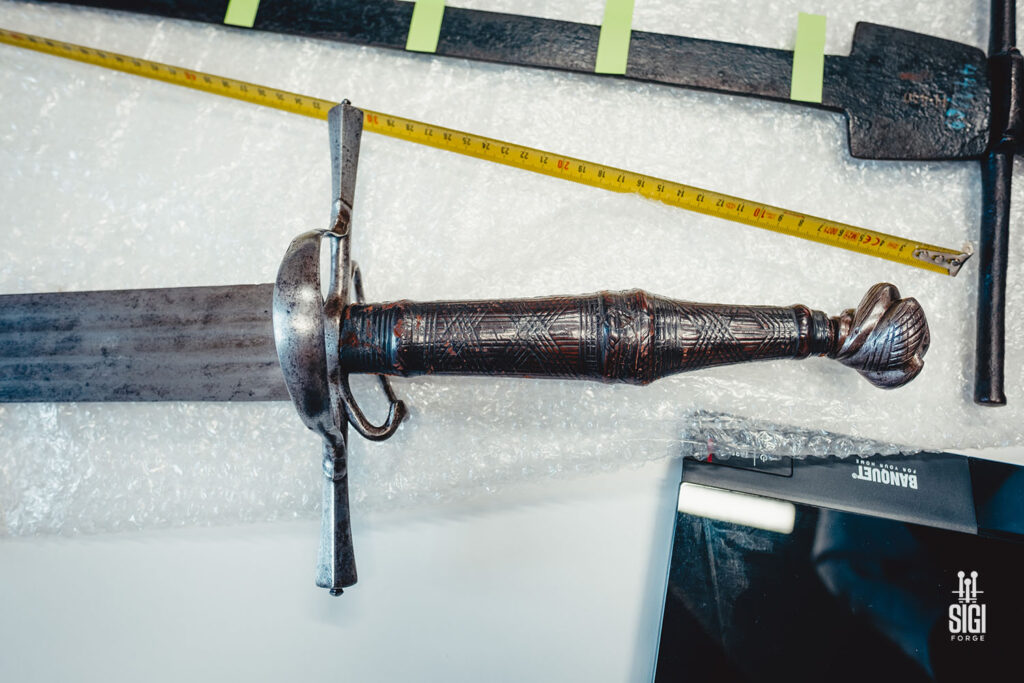
Handling this particular sword in person was quite a surprise. We originally came to examine the feder and had no idea there were other swords in the collection. This piece was absolutely stunning, and we fell in love with it right away.
The Spiš Longsword features a relatively unusual triple-fullered blade. The three fullers run approximately to the middle of the blade, where two of them disappear and a single, central fuller continues all the way toward the tip. The blade reminded us of certain Passau swords of a similar type, one of which can be found in the Royal Armouries, while another was reportedly sold to a private collector a long time ago.
And now comes the fun part—the complex hilt of this longsword is flipped.
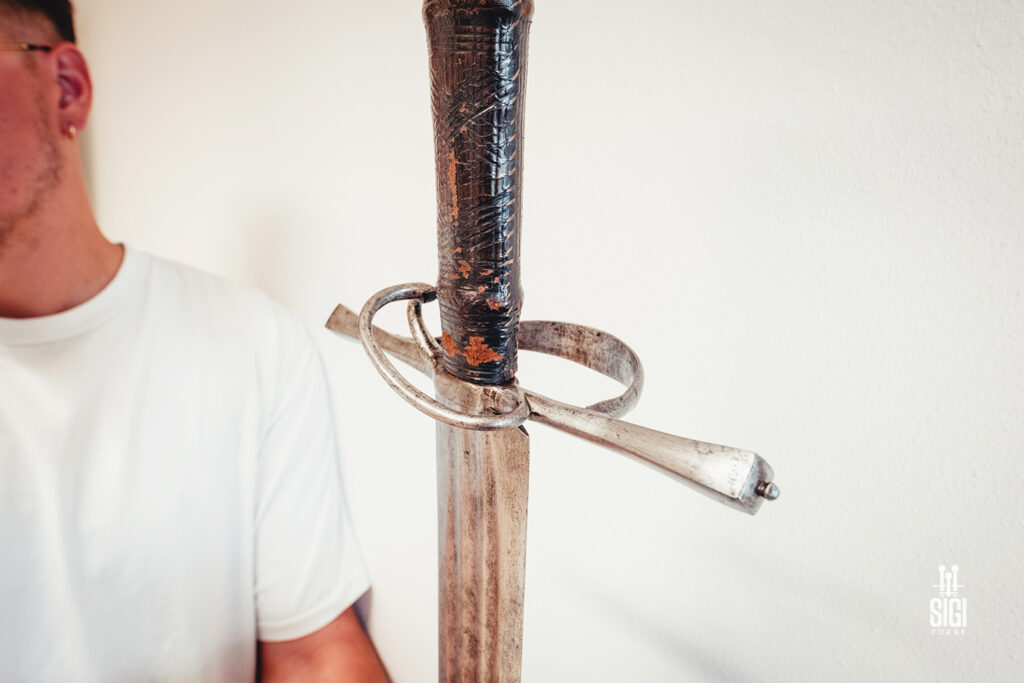
At some point in the sword’s history, the weapon (or at least its hilt) appears to have been refurbished, and the hilt was reassembled incorrectly. This becomes even more amusing when you inspect the ricasso. A visible bevel along the lower edge clearly indicates where the finger ring originally rested.
Once again, we enthusiastically offered our services in correcting this, but the sword has immeasurable value even in its current state. Since the sword is peened, it is difficult to determine whether the reversed crossguard resulted from a misunderstanding of the hilt’s purpose, or whether a smith, renovator, or whoever was responsible for the refurbishment simply fitted a crossguard from another sword and struggled to make it fit properly.
The grip is covered in leather stitched together along its ridge. The leather is further coated with an unknown resin, possibly a lacquer. It is difficult to establish whether this treatment was applied by a conservator in the mid-20th century or earlier, when the Csáky family still displayed their collection.
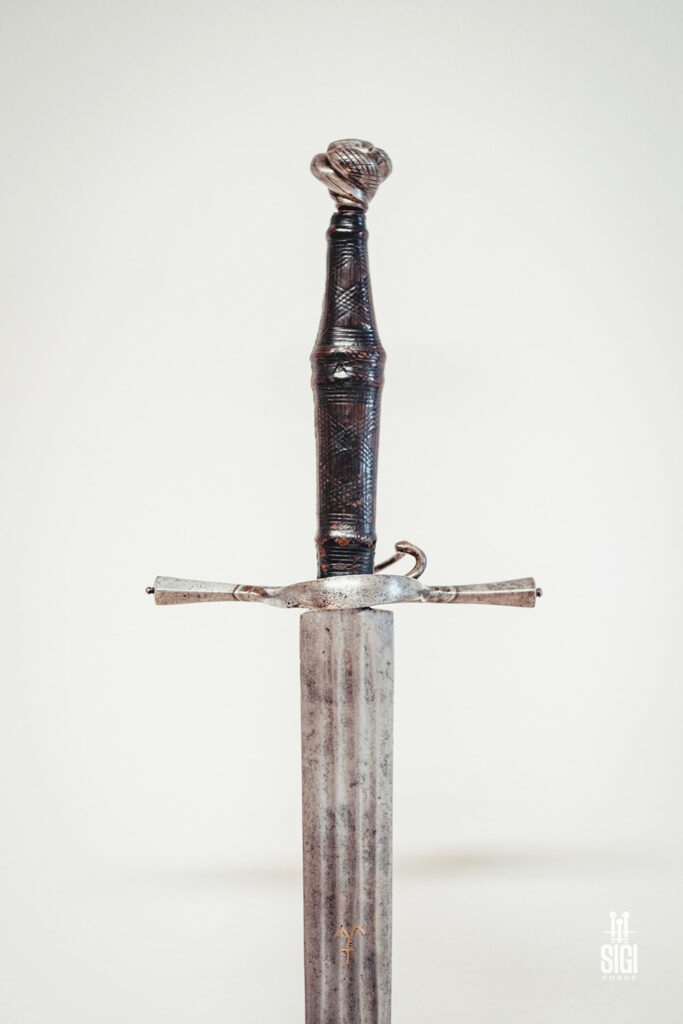
The pommel is peened and beautifully ornamented. It is reminiscent of many other Late Renaissance pommels, so even if it were a 19th-century historicist piece, it would be a very well-executed one.
Apart from the poorly fitted crossguard, the Spiš Longsword feels absolutely amazing in the hands. Despite its compact size—almost exactly that of a SIGI Shorty—the sword weighs 1936 grams, which is relatively common for its class.
This sword was made either to cut or to impress, and we are certainly impressed.
The Spiš Longsword features one final detail worth mentioning. There is an inlay or engraving on the strong of the blade that resembles a sad-looking letter T or perhaps a closed umbrella. The blade bears no other maker’s mark, so we may reasonably assume this is one.

What makes the mark particularly interesting is that we have actually found the exact same symbol elsewhere. Surprisingly, it appears to be one of the Hausmarken from the German island of Hiddensee. These marks function somewhat like a coat of arms for a particular house on the island. They are not associated with a family, but instead are inherited together with the property itself.
If the connection between Hiddensee and this sword is genuine, then the blade must have undertaken quite a journey before ending up—most likely—at Spiš Castle.

Hiddensee Hausmarken. Source: https://www.insel-hiddensee-360.de/hiddensee-hausmarken.html
Naturally, there is always the possibility that the sword was acquired later through an auction or some other means. One way or another, it is difficult to imagine that a blade bearing such a specific mark would be an elaborate fake. The symbol is unusual enough that the connection to Hiddensee seems entirely plausible.
We intend to contact a local museum on the island to see whether they can provide us with additional information.
Below you can find the main measurements we recorded from the sword:
Spiš Longsword (16th-19th century)
Weight: 1936 g
Total length: 1238 mm
Blade length: 967 mm
Hilt length: 265 mm
Crossguard width: 225 mm
Blade width at the cross: 53.8 mm
Blade with at the middle: 45.5 mm
Blade with 1 cm from the tip: 15.5 mm
Thickness at the crossguard: 9.1 mm
Thickness at the middle: 4.6 mm
Thickness at the tip: 2 mm
Pommel height: 43.5 mm
Pommel width: 48.5 mm
POB: 157 mm
Pivot 1 (crossguard hold): 475 mm
Pivot 2 (pommel hold): 235 mm
COP: 590 mm
The Spiš Rapier and the Spiš Saber
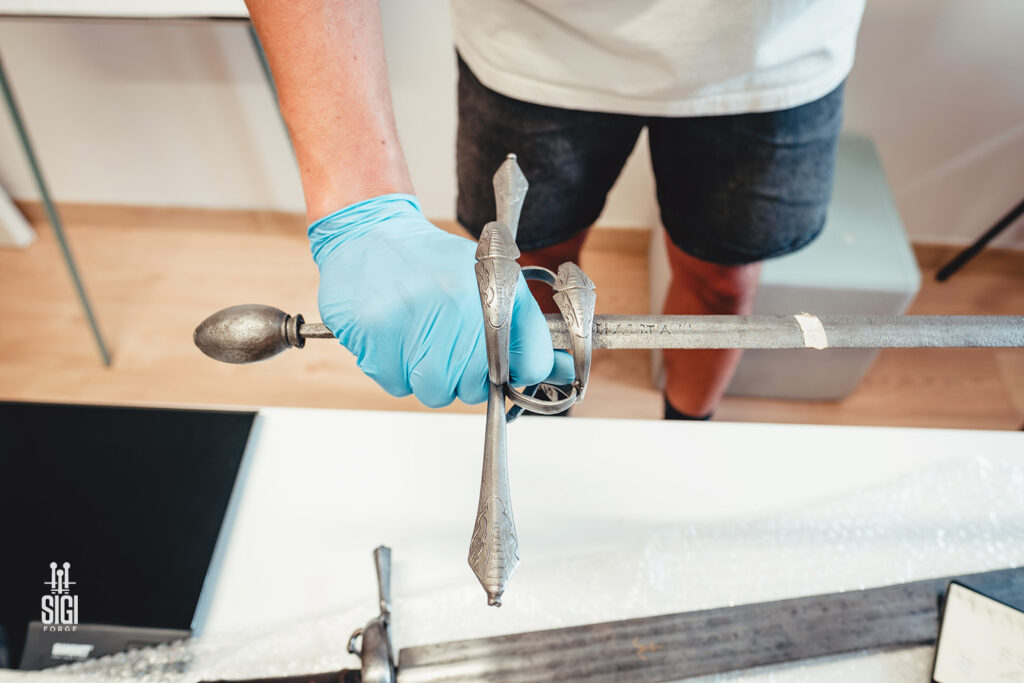
As mentioned earlier, we were also able to examine two more pieces from the collection: a rapier and a saber. The rapier was disassembled and missing its grip. The saber, on the other hand, was an exquisite piece showing many signs of active use. It is impossible to determine whether this wear resulted from battlefield use, regular practice, or perhaps even performance fencing.
The rapier itself was very interesting, as the photographs show. Three things stood out in particular: its weight (714 grams), its tip, and its pommel. The latter two are likely connected—we believe the rapier is broken and blunted. However, even if the sword were missing 10–15 centimeters of its original length, and even if we accounted for the approximate weight of a grip, it would still be extremely light by modern standards.
The reason we mention the pommel is that the internal cavity appears to have been filled with wood or leather. We can only speculate as to why this was done, as this is the first time we have encountered a similar construction method.
The saber, possibly of Ottoman origin, had its hilt refurbished or entirely constructed by the same person who worked on the feder. Not only is it unusually bulky, well beyond reasonable proportions, it also features the same screw-based construction system on the grip.
Like the rapier, it is very light—more akin to a sports saber than a military weapon. This is likely due to a low weight, low point of balance (approx. 12 cm) and the overall blade geometry. Notably, the blade has a pronounced T-shaped strong, transitioning into an extremely thin weak.
Beyond the clear signs of active use, the blade also bears visible etchings with the word “Allah” and additional, so far undeciphered text in what appears to be a poorly executed Old Ottoman script (with thanks to our Turkish friends for their help in identifying this). When discussing these findings with Mr. Ráčay, he mentioned that the museum holds photographs of the Csáky family’s travels in Egypt, and that this saber may have been acquired during that trip—or even on site. Naturally, without further evidence, this remains speculation.
Conclusion
Examining surviving swords is essential for our understanding of medieval and Renaissance fencing. Finding a so-called federschwert in such an unusual location in Slovakia is particularly intriguing, and even if the sword ultimately proves to be a historicist piece or a forgery, the question of why this specific form appears in this context remains just as fascinating.
We are happy to share all of our measurements and photographs with the community. Hopefully, this will lead to further insights, as our own experience—while grounded in modern swordmaking—is not always sufficient to fully interpret the complexities of historical blades. If anything in this article catches your eye that we may have missed, please do not hesitate to contact us so we can share additional findings with the Markušovce Museum and expand the knowledge presented here.
Once again, we would like to thank the Markušovce Museum and Mr. Ráčay for their warm welcome and assistance in examining these pieces. If you find yourself in the Spiš region of eastern Slovakia, we strongly encourage a visit. In addition to the furniture and art collection in Markušovce Chateau, the nearby Markušovce Castle is currently under renovation, and it is always encouraging to see such efforts to preserve history and cultural heritage.
The full album in original resolution can be found here: https://photos.app.goo.gl/8Qp3ZW5bSFyPCZxKA
All photographs may be shared under the CC BY-NC license. Author: Martin Fabian/SIGI.
Yours sincerely,
SIGI